
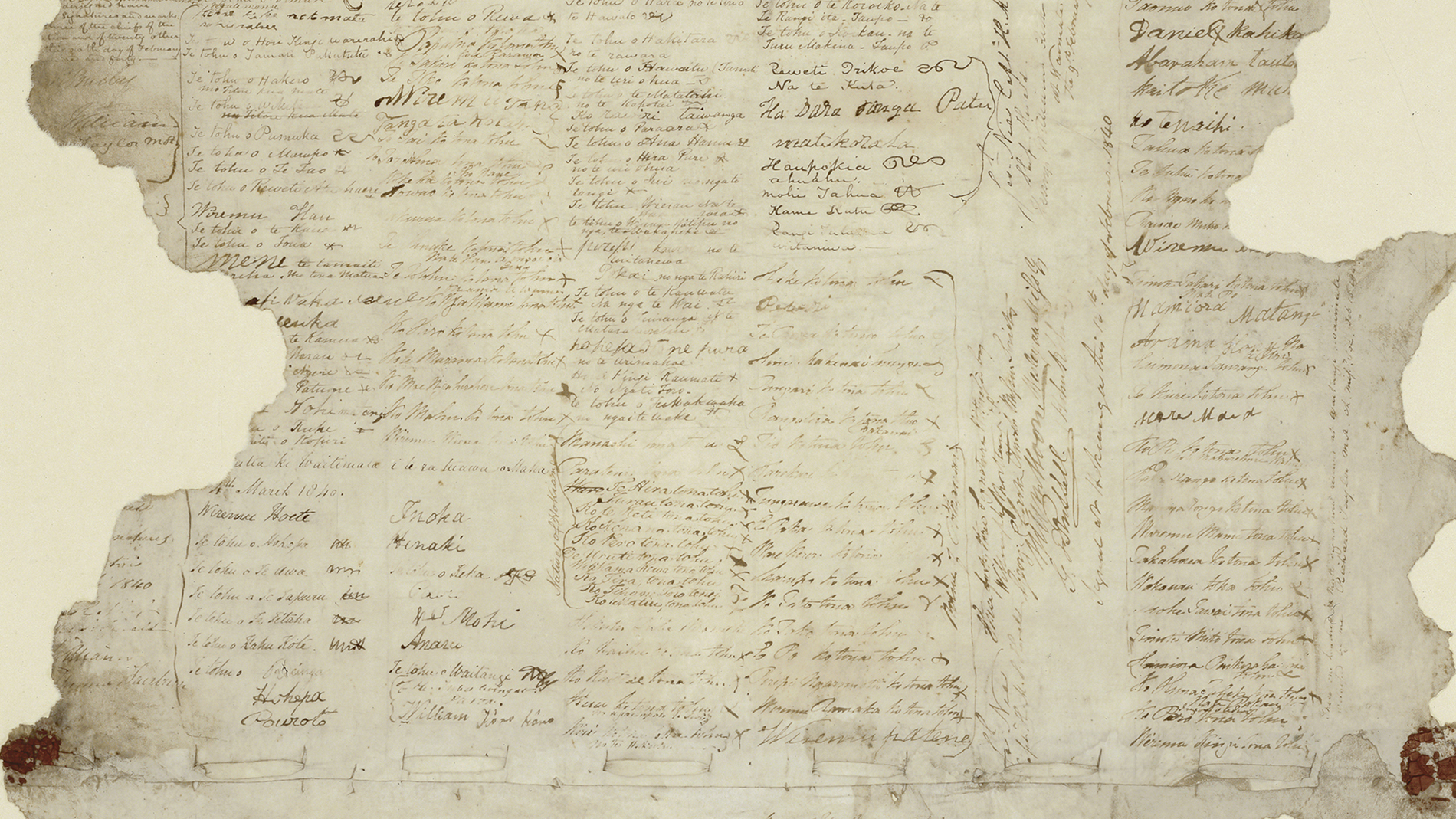
The Treaty of Waitangi underpins the relationships between iwi, communities and the council across the Waikato region.
Here, the Treaty landscape is both complex and continually evolving, shaped by issues ranging from land and fisheries to waterways and cultural redress.
Over the past three decades, the Waikato region has seen significant progress through a series of comprehensive Treaty settlements. These agreements have transformed how iwi, the Crown, and local authorities work together, establishing new frameworks for shared decision making and long term partnership.
Treaty of Waitangi explained
-
The Treaty of Waitangi has two texts, one Māori and one English. The English text is not an exact translation of the Māori text. Despite the problems caused by the different versions, both represent an agreement in which Māori gave the Crown rights to govern and to develop British settlement, while the Crown guaranteed Māori full protection of their interests and status, and full citizenship rights.
Meaning of the Treaty
The English version of the Treaty
The Māori version of the Treaty
Treaty landscape in the Waikato region
The Waikato region is one of the most significant and complex Treaty settlement landscapes in Aotearoa New Zealand, shaped by several comprehensive settlement agreements between iwi and the Crown.
These settlements include:
- Waikato Tainui Raupatu Claims (Waikato River) Settlement Act 2010
- Ngāti Tūwharetoa, Raukawa, and Te Arawa River Iwi Waikato River Act 2010
- Ngā Wai o Maniapoto (Waipā River) Act 2012
- Raukawa Claims Settlement Act 2014
- Ngāti Tūwharetoa Claims Settlement Act 2018
- Maniapoto Claims Settlement Act 2022
These settlements establish co management arrangements that give iwi a meaningful role in the governance, protection and restoration of natural resources alongside central and local government agencies.
Other iwi with settlement arrangements relevant to the Waikato region include Ngāti Pāoa, Ngāti Tara Tokanui, Ngāti Hauā, Ngāti Koroki Kahukura, and others whose rohe extend across regional boundaries.
How Treaty settlements shape council-iwi relationships
Essentially, Treaty settlements set out statutory requirements for councils and iwi to work in good faith, act consistently with agreed principles and participate jointly in planning and resource management. They also establish collaborative approaches to monitoring, environmental management and shared governance.
As new settlements progress and resource management legislation evolves, the Treaty landscape will continue to change. These developments will shape how we work alongside iwi and hapū to care for the region’s environment.
Our role
Through Treaty settlements, iwi and the Crown have set clear expectations for how decisions about the region’s environment should be made. Waikato Regional Council plays a central role in giving effect to these commitments.
Treaty settlements guide how we work with iwi authorities, Post Settlement Governance Entities, co governance partners and other agencies to care for the region’s rivers, lands and natural resources. This includes planning together, sharing information and making decisions that reflect iwi aspirations and the agreed visions for the region.
A core principle across all settlements is the recognition that iwi are Treaty partners with deep, enduring relationships to their whenua, waterways and wāhi tapu. These relationships shape how we approach environmental management, resource planning, monitoring, and long term restoration work. They also guide how we uphold Joint Management Agreements, recognise iwi environmental plans and ensure our decisions align with settlement legislation.
In practice, this means working collaboratively, acting in good faith, and supporting effective co-management and co-governance across the region.