
SuperLocal award win for council’s Pathways to the Sea strategy
| Published: | 16/10/2026 |
Waikato Regional Council’s Ngā Rerenga ki te Moana | Pathways to the Sea has won a second national prize, last night taking home Local Government New Zealand’s SuperLocal Award for its environmental stewardship.
The strategy – developed to provide safe downstream passage for tuna (eels) and other native fish through flood protection infrastructure – was a finalist in the SuperSteward Award - Tū Tiaki category. The SuperSteward Award recognises councils that take responsibility for protecting the environment and managing resources for future generations.
In accepting the award, chair Warren Maher said the project began with a simple challenge: how do we continue protecting communities from flooding while also protecting the native species that rely on our waterways?
“For decades, many of our pump stations unintentionally created barriers for migrating tuna and other native fish. Over six years, we worked alongside iwi and mana whenua, researchers, engineers and pump builders across New Zealand and overseas to find practical solutions. Together we've tested new technologies and upgraded pump stations.
“What we're particularly proud of is that this work moved beyond research and into everyday practice. It's now shaping how we manage and modernise our flood protection network for the future. And importantly, we’re achieving fish passage rates of up to 100 per cent at some sites, helping more than a tonne of tuna transfer safely during a migration season.”
He acknowledged the project’s 14 funding partners, including from central and regional government, as well as research collaborators, in particular Waikato-Tainui and the Waikato-Tainui College for Research and Development, whose partnership and leadership was integral to this success.
Cr Maher also thanked “the dedicated Waikato Regional Council staff who worked over many years to bring this vision to life”.
“This award belongs to everyone who has helped demonstrate that protecting people and restoring the health of our waterways can go hand in hand,” Cr Maher said.
Waikato Regional Council has more pump stations than any other council in Aotearoa New Zealand. Many of these pump stations were constructed decades ago, and with little consideration for ecological impacts. They prevent safe downstream migration of fish species and can cause a high level of injury and mortality for long-lived native tuna (eels).
The strategy embeds ecological outcomes into infrastructure planning and is grounded in a six-year, evidence-based research programme undertaken by council staff.
The research programme tested fish friendly solutions, including new pump technologies, gravity bypasses, electrical deterrents and trap and transfer operations.
Altogether, more than 20 technical reports were produced, and the research generated significant national and international interest.
Field tested pumps – including a New Zealand designed retrofit prototype – achieved safe passage rates of between 74 and 100 per cent.
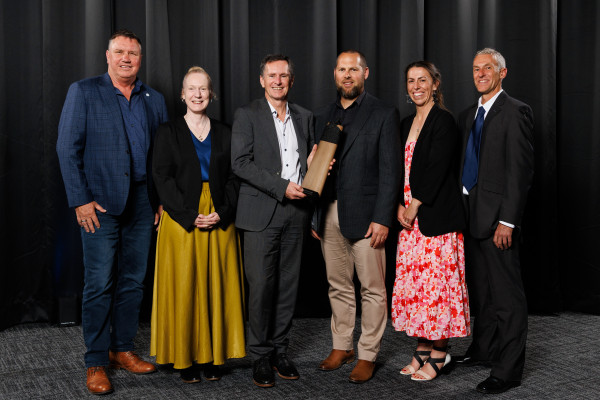
(L-R) Waikato Regional Council Chair Warren Maher, Senior Policy Advisor Michelle White, Chief Executive Chris McLay, Integrated Catchment Management Director Greg Ryan, Senior Freshwater Ecologist Alicia Williams and Reliability Engineer Steve Hall.