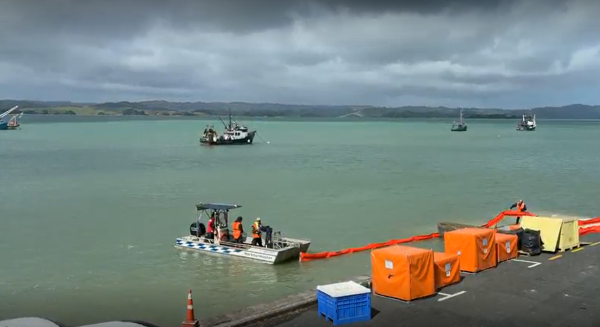
Kāwhia oil spill exercise draws community interest
| Published: | 30/09/2026 |
Kāwhia Harbour this week provided the setting for a large-scale marine oil spill response exercise that attracted interest from the local community.
Training exercises are held twice a year by Waikato Regional Council in different locations around the Waikato rohe (region), as part of our Maritime Transport Act obligations to test the preparedness and capability of responders to Tier 2 (regional) spill events.
This year’s field-based scenario involved the hypothetical sinking of a 37-metre commercial vessel off Tauratahi Point near Kāwhia Harbour mouth resulting in approximately 7000 litres of hydrocarbon leaking into the water and spreading into the harbour on an incoming tide.
Exercise Kārewa, held on Tuesday (29 September), brought together Waikato Regional Council’s operational, harbourmaster and incident management staff. Teams were tasked with deploying containment booms and managing key response functions, including oiled wildlife response, intelligence, planning, logistics, communications and iwi liaison.
The exercise was independently assessed by Maritime New Zealand (MNZ).
Waikato Regional Council Regional On-Scene Commander (ROSC) George McQuillan authored the exercise and said it was designed to test the limits of a regional response while reflecting the challenges of a realistic spill event.
“While we hope never to need to respond to an event of this scale in real life, spills affecting our region’s coastal and marine environments do occur from time to time, requiring the council to lead and manage significant responses which draw upon staff from across the organisation. That’s why it’s important we regularly put our people, equipment and systems to the test,” Mr McQuillan said.
“We saw strong community interest in the exercise, with mana whenua, local marine farm staff and members of the Kāwhia Boating and Angling Club joining us to share their intimate knowledge of the moana and gain a better understanding of the complexities involved in responding to a marine oil spill in their particular rohe.
“Conditions on the day included high spring tides, strong winds and choppy seas, all of which would influence a real response. Our teams also had to consider the proximity of marine farms, nearby shellfish beds, native wildlife and sites of significance to iwi.
“It was a challenging scenario but the ROSC for the exercise did a fantastic job leading a team of engaged and enthusiastic people toward a common goal of minimising the impact of the spill on the environment. In a real event, marine oil spills pose wide-ranging risks to wildlife, economic activities, and cultural and recreational values, highlighting the importance of us being prepared to respond swiftly and effectively,” he said.
The exercise was funded by the Oil Pollution Fund, administered by MNZ.