
“National direction through the New Zealand Coastal Policy Statement requires the protection of significant surf breaks, and our coastal plan gives effect to this. In practice, this means resource consent applications for activities need demonstrate they will not affect the surf break or the swell corridor.”
Waikato Regional Council Coastal and Marine Team Leader Dr Michael Townsend
More than 6,500 people watched from the shoreline. Millions tuned in around the world.
The World Surf League event in Raglan delivered exhilarating action, including the season's first perfect 10 from Brazilian Yago Dora.
Yago's perfect performance relied on near-perfect conditions. And conditions this good aren't just left to chance. They're protected from source to shore – through science, environmental safeguards and smart on-water management.
This protection plays an important role in attracting events like the WSL to places like Raglan. Because, from the spectacle enjoyed by fans to the positive ripple-effects for tourism and the local economy, it was the pristine surf that made it all possible.
Behind the scenes, Waikato Regional Council's regulatory and consenting role helps protect the environment at places like Manu Bay, and its active management of on-water activities during the WSL prevented disruption to the event itself.
The bay is one of 17 surf breaks of national significance in New Zealand. Waikato Regional Council Coastal and Marine Team Leader Dr Michael Townsend says that gives it special protection from inappropriate use and development.
"National direction through the New Zealand Coastal Policy Statement requires the protection of significant surf breaks, and our coastal plan gives effect to this. In practice, this means resource consent applications for activities need demonstrate they will not affect the surf break or the swell corridor.
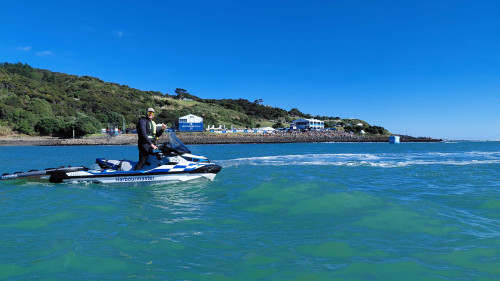
Maritime Services enforce exclusion zone for WSL competition
"They're unique coastal features with significant cultural, spiritual, recreational and economic value. This value depends on the integrity of natural processes, so it's vital we understand and look after them."
Manu Bay's world-class waves exist because of a unique interaction between hydrodynamics, coastal morphology and weather, says Coastal and Marine Scientist Dr Stephen Hunt.
"The waves are generally formed by storms deep in the Southern Ocean and the prevailing south-westerly winds in the Tasman Sea. As the swell hits the coastline, it refracts and wraps around the headlands and into Manu Bay.
"The waves are surfable regardless of the tidal level and the headland can provide valuable shelter from the southwesterlies."
The water quality is also graded "excellent", based on long-term Waikato Regional Council monitoring at nearby Ngarunui Beach.
The wave Yago rode had a long journey, but the final stretch would have been the most challenging had it not been for the work of the council's Maritime Services Team.
Boat wakes can wreak havoc with wave quality, cancelling out natural wave energy or combining with it to create choppy, messy, far less surfable conditions. But the team was out in force, enforcing the rules on the water to support the event.
Recreational Harbourmaster Hayden Coburn says: "Our role was managing on-water boating safety and protecting the integrity of the competition area."
The World Surf League event operated under a Temporary Maritime Event permit issued by Waikato Regional Council, which enabled controlled exemptions to our Navigation Safety Bylaw.
"Under normal circumstances, the Bylaw protects surfers in the surf zone 200m up the coast and 500m offshore – meaning boaties must have a spotter, can't exceed five knots and must not impede surfers in any way," says Hayden.
"During the competition, the exclusion zone was 1000m by 1000m around the event site. This protected wave quality by ensuring no vessel wake interfered with incoming sets."
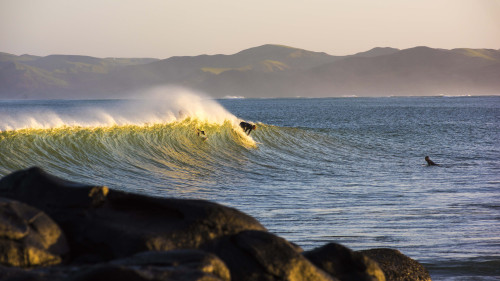
World-class waves at Manu Bay
Six maritime officers were rostered on during the event and intercepted 25 vessels attempting to enter the exclusion zone. The team also worked closely with the WSL on-water teams and Maritime Police.
They even faced a code red wildlife incident. One WSL cameraman was bitten during the men's semi-final, but the jet ski team was already nearby and made a swift rescue.
Long-term protection of special places like Manu Bay and having the capacity to support events like the WSL directly is about more than just surfing. It's an investment in local communities.
According to Hamilton and Waikato Tourism General Manager Nicola Greenwell, anecdotal evidence suggests the event's economic impact was promising, with good reason to expect both short and long-term uplift from hosting international events like the WSL.
"Early reports suggest Raglan's population swelled to summer highs and local cafés saw record numbers," says Nicola.
"We don't have official regional tourism estimates yet. But with crowds of up to 6,500 at what is normally a low point of the season, the year-on-year increase in short-term visitor numbers is expected to be significant.
"With millions watching worldwide, we'd also expect events like this to have a positive long-term impact on regional tourism numbers."