
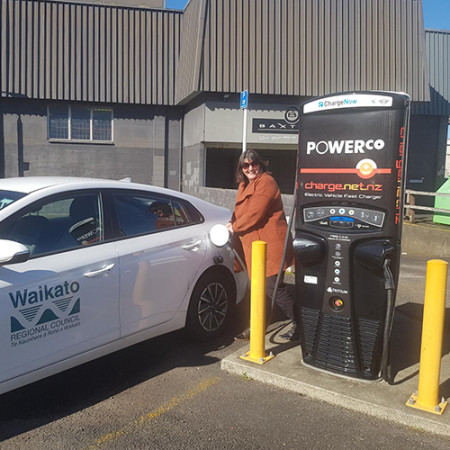
Julie Hansen charges one of our electric vehicles in Thames.
Waikato Regional Council’s transport policy and programmes team has been working with councils and other agencies to produce the region’s, and likely New Zealand’s, first guidelines for electric vehicle (EV) charging stations on council land.
In early 2022, charging infrastructure companies were approaching district councils asking to install charging stations on council land, but council staff had no framework to evaluate the merits of individual stations or to ensure our regional charging network would develop in a way that supports good community outcomes.
New Zealand’s EV fleet is growing but our approximately 85,000 EVs make up just under 2 per cent of the national light vehicle fleet today. Julie Hansen, senior policy advisor – transport and infrastructure at Waikato Regional Council, says once we reach the 5 per cent threshold, we will likely see a mainstreaming effect and accelerated growth of our EV fleet. This will increase demand for charging, making now the time to set the future of our charging network in the right direction.
Julie says charging infrastructure supports a significant shift in motoring behaviour: a two-minute stop to refuel the tank is about to become a half-hour stop to recharge the battery. Change like this requires a lot more thought and planning than simply installing a charger. Charging speed, adaptor types, accessibility, lighting and safety, location, nearby amenities and a range of other factors will impact the usability of each site. Someone also needs to oversee the structure and integrity of our wider regional network and encourage providers to cover gaps in places like Thames-Coromandel, which has only four chargers despite being a popular summer destination, and towns like Kawhia, which currently has no chargers.
After recognising the need to beat the surge, a small group of transport personnel from Waka Kotahi and Waikato Regional, Hamilton City, Waikato and Waipā District Councils came together for “just a bit of a chat”. They knew something needed to be done but had no established way to go about it. The only comparable example they could find came from the City of Parramatta in Sydney; however, producing separate guidelines at city or district level means a lot of duplicated effort and more potential for inconsistency across the region.
Fortunately, Waikato is now ahead of the game as the small initial group grew to include every council in the region, Department of Conservation, Te Waka (economic development agency) and CoLAB (multi-council innovation and shared services company). They agreed that the guidelines needed to be useful straight away: people are building new charging stations right now. So they produced a toolkit that includes licensing templates, memoranda of understanding, reports, guiding principles, and assessment criteria for staff making decisions. Individual councils will assess their own proposals, but the guidelines promote consistent standards and processes across the region, which helps EV companies too because they get the same response from each council.
Julie says the first group was essential to get the project off the ground and collaboration was critical to inform the guidelines with solid information. The group was able to find and incorporate advice from experts in the area, most of whom work for infrastructure organisations rather than councils themselves. She also says building relationships with colleagues from other organisations was one of the most rewarding aspects of the process, and they are already talking about using the model again to solve other transport problems like reducing emissions and adopting new technologies. Generous sharing of knowledge and resources has produced a document that helps prepare Waikato’s EV future, and other regions are welcome to adapt them to their own needs if they wish.
The guidelines are freely available on Waikato Regional Council’s website.