
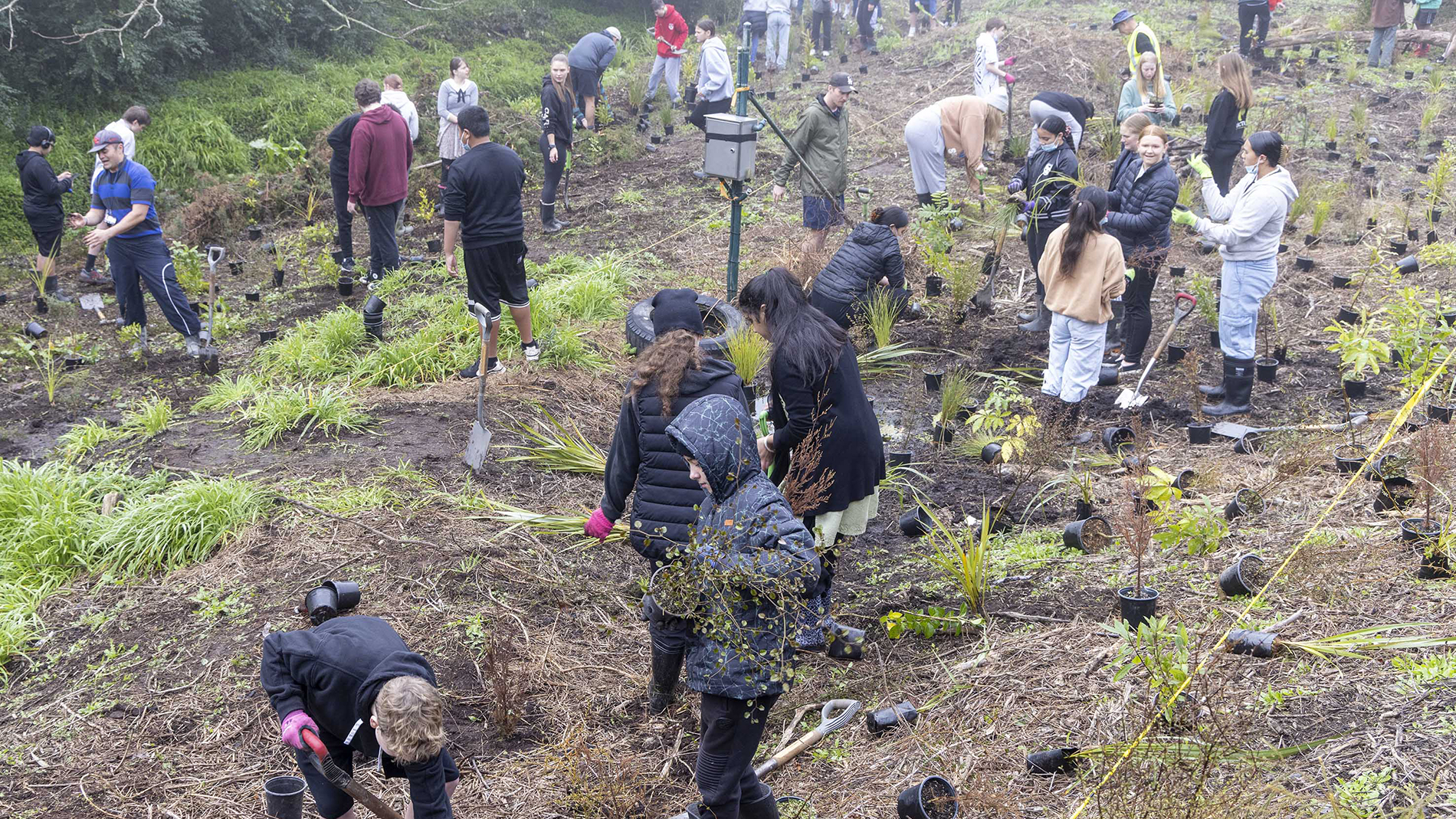
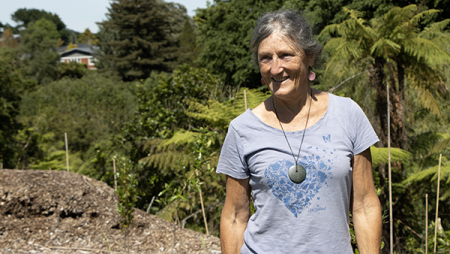
Lyn Rogers says the gully restoration is an opportunity for students to learn environmental science.
For Fairfield Project co-ordinator Lyn Rogers, restoring Kukutāruhe Gully bordering Fairfield College in Hamilton is all about leaving a legacy for students.
The former science teacher, who helped spur the Fairfield Project in motion back in 2014, says when she taught at Fairfield College, the gully was full of rubbish and overgrown with every pest plant imaginable.
“It wasn’t feasible to take my students in the gully as a science teacher so, for me, the Fairfield Project is about creating a learning environment that other teachers can use,” says Lyn.
“It’s an opportunity to connect students, and the community, to the restoration that’s happening, as a place they can go to and learn about ecology, conservation, pest management, environmental monitoring, mautaranaga and promoting kaitiakitanga.”
The Fairfield Project, led by the Kukutaaruhe Education Trust Board, was established to foster environmental education for people of all ages.
The seed of the project was planted by chair Vic Arcus, a biology professor at the University of Waikato, as an alternative to a proposal put forward by the Ministry of Education to sell 12 hectares of Fairfield College school grounds for housing development, including the 8ha gully.
“The community saw it has a valuable green space,” says Lyn.
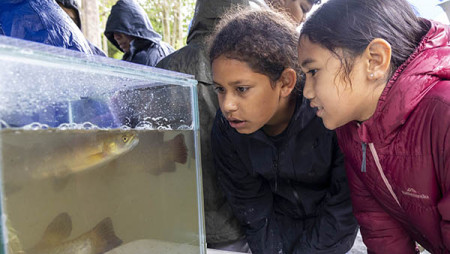
The Kukutāruhe Stream has been identified as a giant kōkopu spawning site.
“This land was a place of abundance, with two pa sites. The gully was their kai basket, with fish in the streams and birds in the bush.”
The Kukutāruhe Stream, a tributary to the Waikato River, had also just been identified by NIWA as a giant kōkopu spawning site.
“We were not at all keen to see this land turned into housing, and if it had been developed then it would have been hard to look after the stream and the taonga species in it.
“More than 300 people turned up to a community meeting in support of keeping the land, and the trust was set up to make that happen.”
Fast forward to 2026 and thousands of volunteer hours have gone into gradually restoring the gully to recreate the biodiversity it once had.
Thousands of students have gone into it to learn about the restoration process, including taking part in an annual Bioblitz where they become citizen scientists by monitoring life in Kukutāruhe Gully, for example, doing bird counts, macroinvertebrate monitoring to assess stream health, and identifying regenerating plant species.
To make all this happen, the trust actively seeks partnerships, collaboration and funding for the project.
It was one of 15 community projects to get a grant from Waikato Regional Council’s Environmental Initiatives Fund (EIF) in 2025, receiving $23,944 to support project management of the ecological restoration.
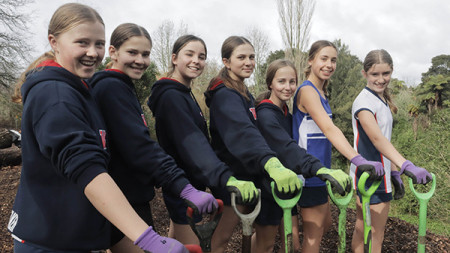
Most of the planting is done by students from Waikato Diocesan School for Girls and Fairfield College.
Trustee and project volunteer Roger Cox says planting has been ongoing for nine years now, under the direction of ecologist and “gully guru” Bruce McKay, with over 35,000 native trees in the ground so far.
“We’re really grateful for the EIF funding,” says Roger.
“Bruce has now employed an assistant, and they’ve been upgrading the nursery – increasing capacity and improving the reliability of the watering system.
“We clear a chunk of land every year for restoration, to recreate the biodiversity of what was here before.
“There’s already canopy cover from the first load of plants that went in in 2016.”
Preparation for planting is done by volunteers and contractors, with most of the planting done by the two schools that border the gully: Fairfield College and Waikato Diocesan School for Girls.
“It was a huge job, starting out,” says Roger.
“We removed skiploads of rubbish from the gully, including loads of concrete from an old milking shed that was part of a farm here before it became a school.
“The first two years, volunteers did a lot of the grunt work but then we tapped into Waikato River Authority funding and that allowed us to get in contractors in to do the heavy lifting to help clear the land for planting.
“There’s about 19 in our regular group and our biggest job is maintenance after the planting, making sure the young plants don’t get overwhelmed with weeds and grass growth.”
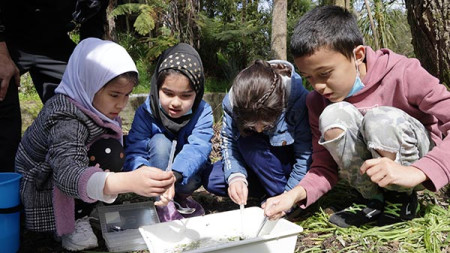
Aquatic insects and other small invertebrates from the stream are an indicator of stream health.
Both Lyn and Roger say there’s been a notable increase in bird life since the project started, rattling off a roll call of birds in attendance.
Ruru and tūi breed in the gully; along with pīwakawaka and shining cuckoo/grey warblers; there are pūkeko, spur-winged plovers, pheasants and their babies; the occasional kereru visits and kākā will come and sit.
“So, we get excited about these things,” laughs Lyn.
“This place is really special, watching it grow.
“I notice that the kids who struggle in the classroom, find it hard to attend school, they blossom outside. Every time they have something here in the gully they turn up to school, and they’re running around with their big rats they have found in the traps.
“It helps them to realise there are pathways for them, outside an academic setting.”
Waikato Regional Council Biodiversity Partnerships Lead Nicky Ismay says one of the objectives of the Environmental Initiatives Fund is to inspire and educate people in the region about biodiversity work and to understand and place value on it.
“It’s great to be able to support projects such as this that help engage and inspire future generations to care for our biodiversity.”